Your photo collection is a treasure. Right now, it's a treasure nobody can find.

We turn thousands of unsearchable scans into a living, searchable archive your team can use from any browser. Not a promise — below is a real archive of 35,575 photographs.

No expensive software · No technical staff · No vendor lock-in

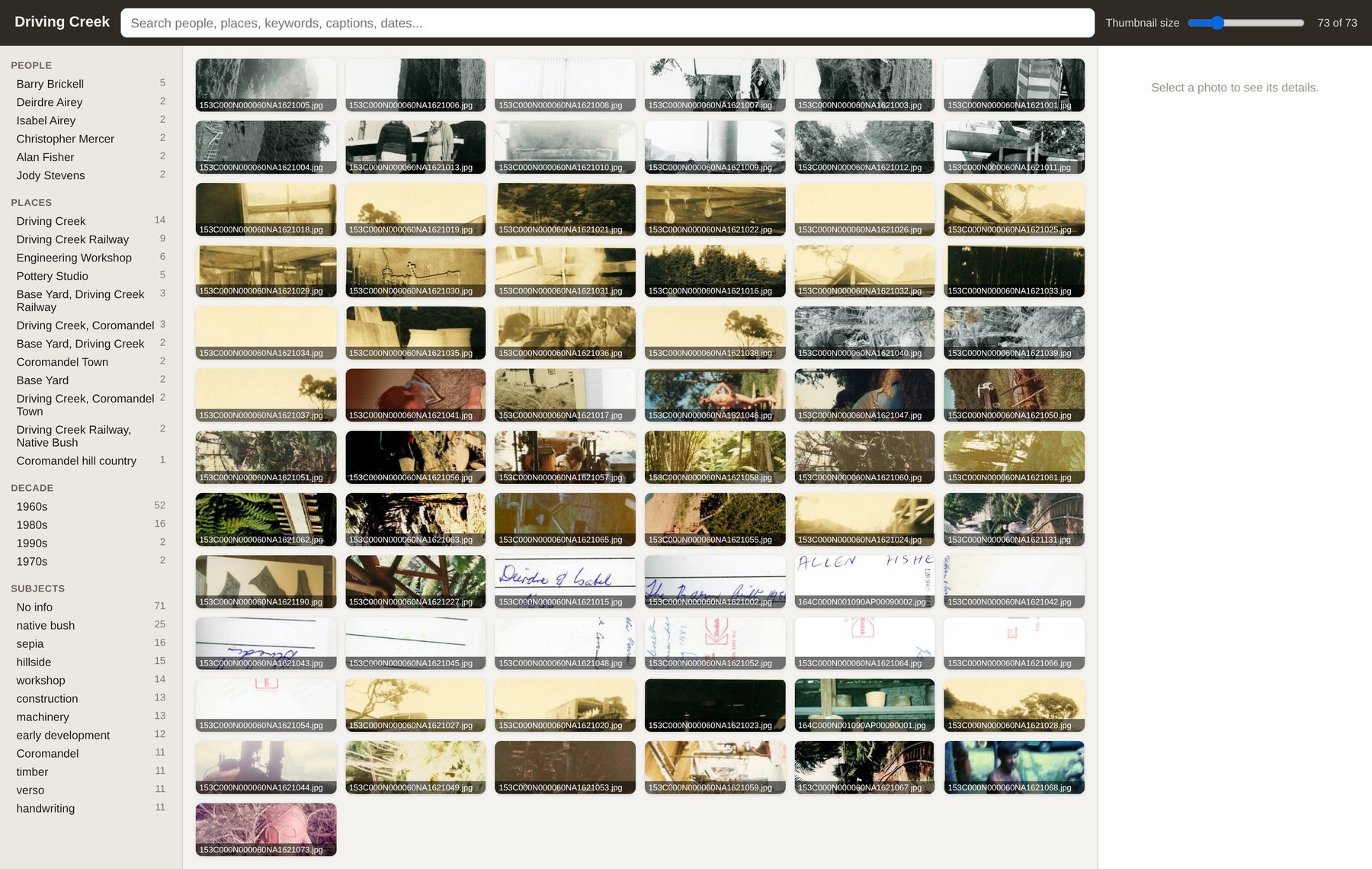
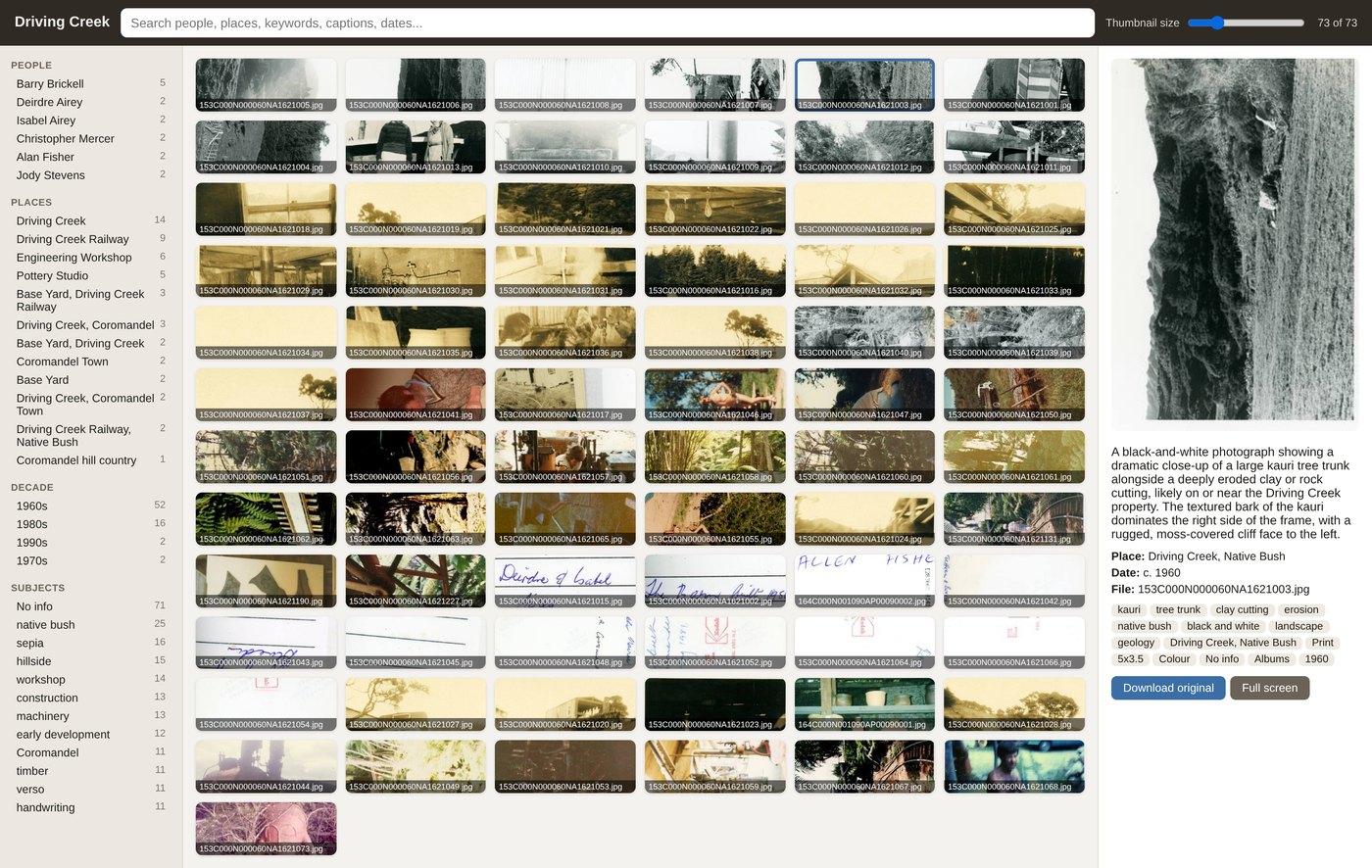
The live Driving Creek archive: a search for 'kiln firing' returns 2,471 of 35,575 photographs, with AI-expanded matching, faceted filters for people and places, and a full catalogue record open beside the results.

↑ The live archive. Searching “kiln firing” — the AI quietly includes glaze firings, wood firing and the anagama too.

The situation we keep finding

A collection that exists, but can't be used.

Whether you're a historical society, a small museum, a heritage railway or a family estate, the story is almost always the same.

Thousands of images on a drive, named with codes like 164C000N001090AP00090001.jpg, buried in nested folders, findable only by remembering where they are.

A spreadsheet with thin, inconsistent notes — a few rows richly described, most effectively blank as far as searching by content goes.

Knowledge locked in people's heads and handwritten on the backs of prints — names, dates and places no search tool has ever been able to read.

No budget and no IT staff. Commercial archive platforms are priced for corporations and assume a technical team you don't have.

Your "photo archive" is a Facebook page. The community loves the old photos — but nothing posted there can be searched, filtered, or kept safe for the long term.

The grant paid for scanning — not findability. The digitisation project finished years ago, and the scans have sat in folders ever since.

What Archiver does

We make every photograph findable — and keep it that way.

We use AI to describe every image in your collection, write that knowledge permanently into the photo files themselves, and publish the whole archive as a fast, private search site your team can use from any browser.

🔍

Findable

Search by who, where, when and what — people, places, decade, subject — in your own words. Ask for "native birds" and the AI finds the tūī and kererū too. Seconds, not an afternoon.

🛡️

Durable

The descriptions are written into the image files in open standards any photo tool can read. No proprietary database to lose, no platform to outlive you.

🪶

Affordable

About a cent a photo to catalogue, and hosting with no per-seat fees and no bandwidth bills. Built for a volunteer budget, not a corporate one.

🔒

Independent

Your files stay on your drive, behind your own login. Nothing is surrendered to a platform. You keep control of your images, always.

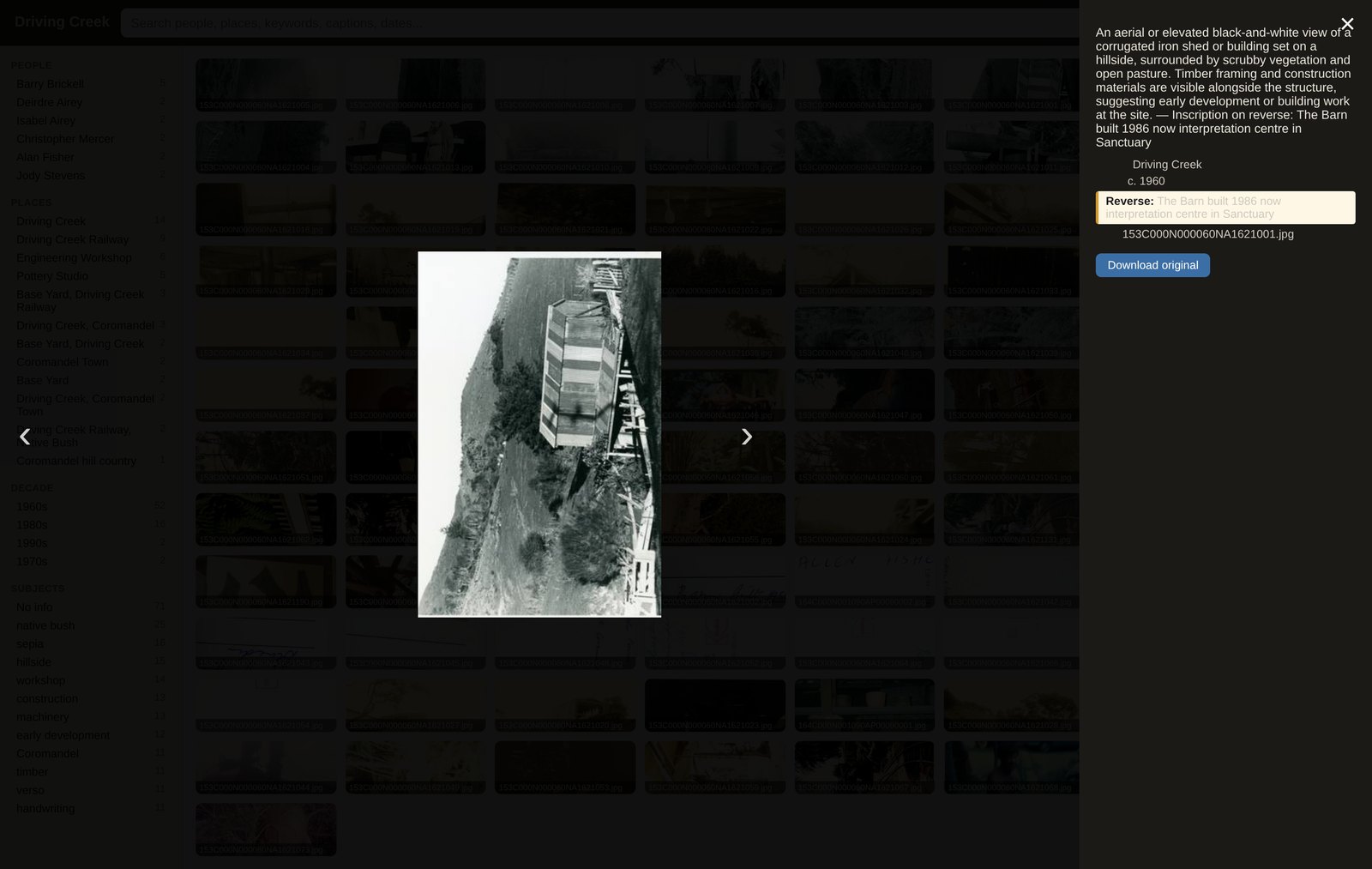
The full-screen viewer: a c.1978 photograph of the No. 1 viaduct under construction, with the handwritten inscription recovered from the back of the print shown beside it.
The thing no one else does

We read the writing on the backs of your photos.

For generations, the most precious knowledge in an archive has been hidden in plain sight — names, dates and places handwritten on the reverse of prints. Archiver reads that handwriting, links each back to its front, and surfaces it right beside the image. The photo here carries its own: "BB No 1 viaduct, about 1978–9, check rails not yet installed."

It's provenance recovered before the people who remember it are gone. On our flagship collection, we recovered and linked 3,147 photo-backs this way.

See it working

Not a tidy demo — a real archive of 35,575 photographs.

Everything below is the genuine, living system — built end-to-end for the Driving Creek Railway & Potteries collection in Coromandel, New Zealand, and still growing as the team adds new photos.

Find anyone by name — one click

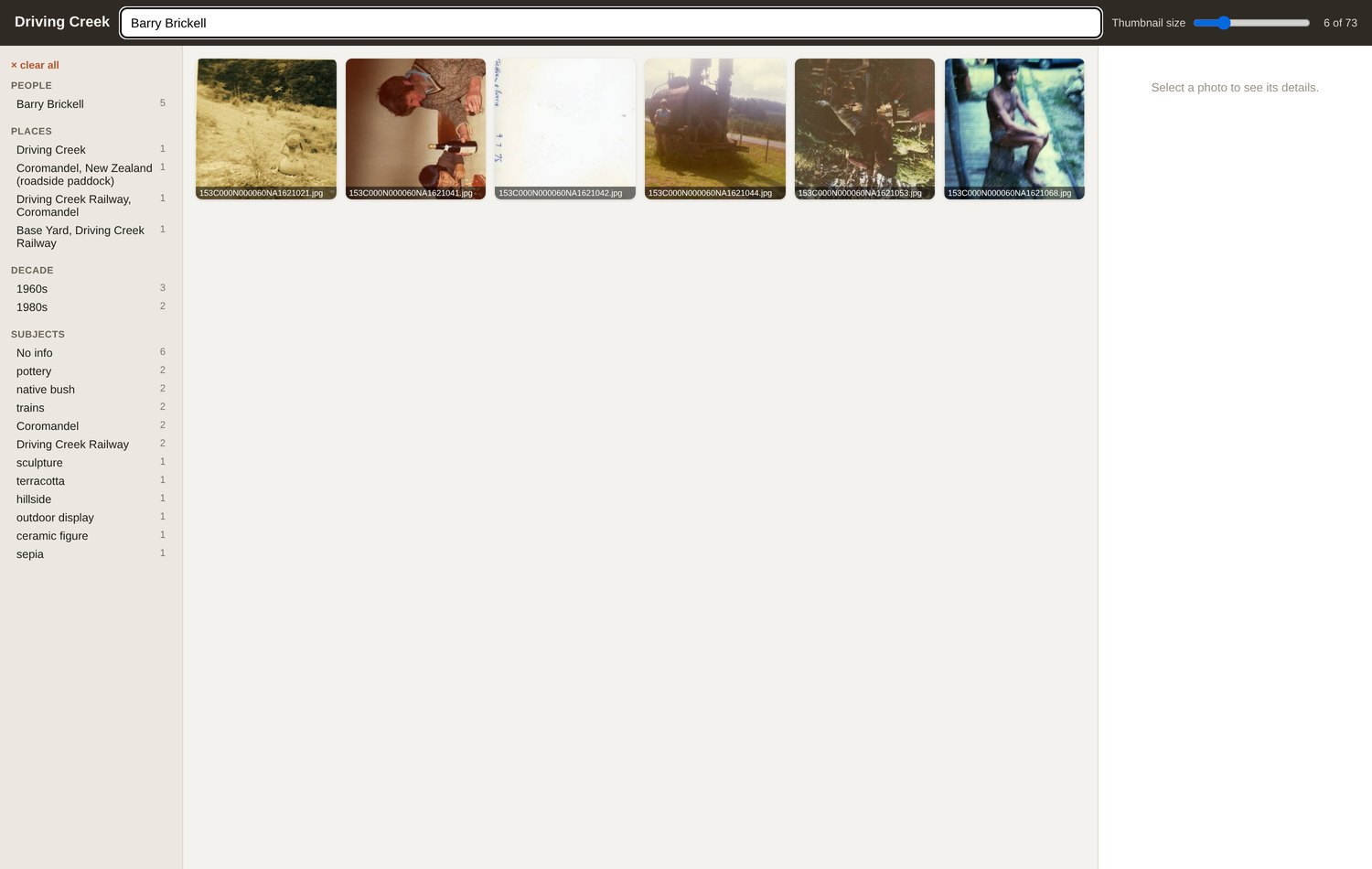
Click Barry Brickell in the People filter and his 2,498 photographs surface instantly — at the wheel, in the workshop, on the railway he built. Every person, place, decade and subject in the collection works the same way.

The archive filtered to Barry Brickell: 2,498 of 35,575 photographs, with the People facet highlighted and a grid of his pottery and workshop photos.

The whole collection, at full scale — and editable

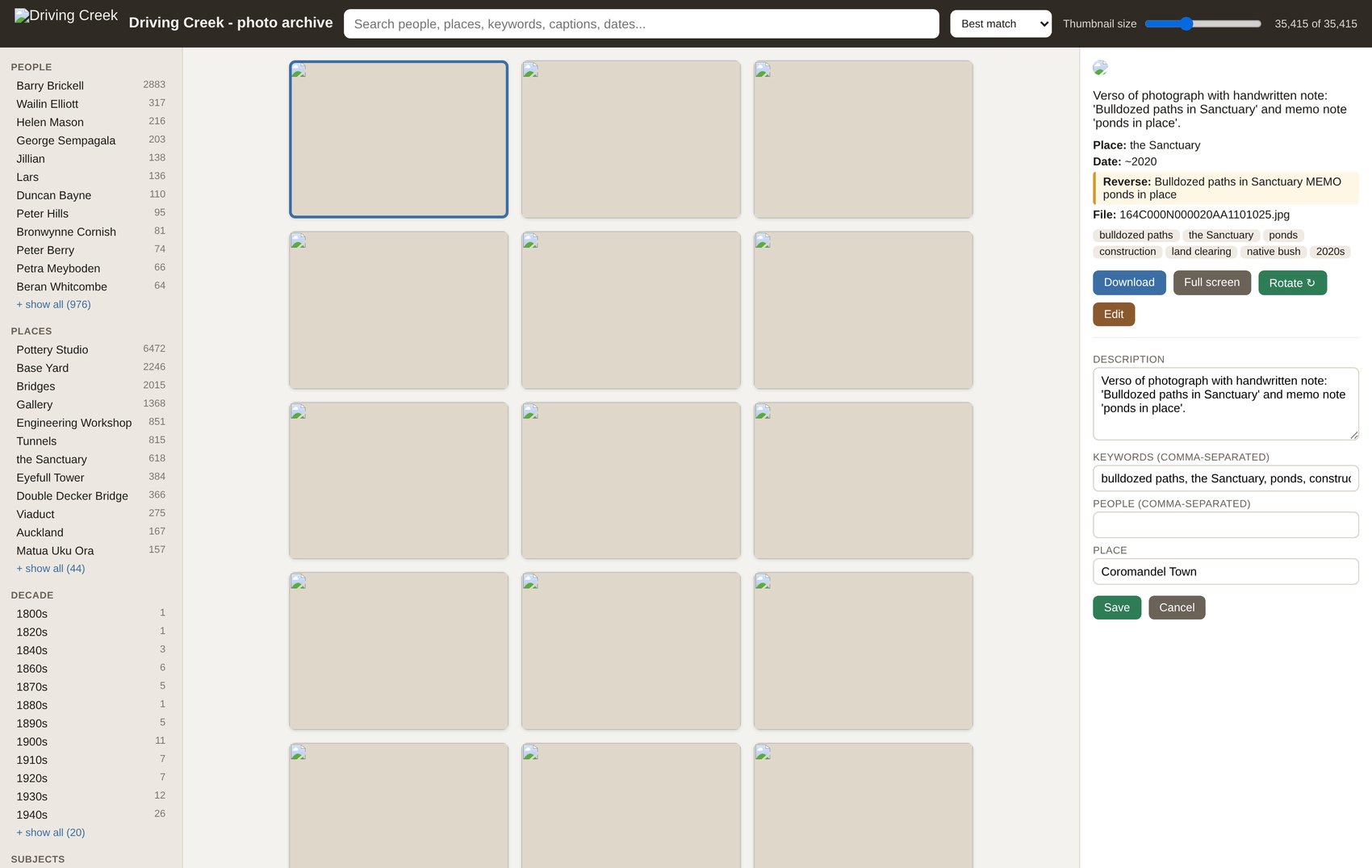
All 35,575 photographs, fronts and backs together, with a rich filterable vocabulary of real people, places, decades and subjects. Your team can correct a caption, fix tags or rotate an image right in the browser — every edit is preserved and attributed, and the AI's work is never lost.

The full archive showing 35,575 records with an in-browser edit form open: description, keywords, people and place fields with Save and Cancel.

Deep detail on every single image

Each photograph carries a full record — caption, people, place, date, tags — with one-click download of the full-resolution original for publications, exhibitions and research. See the (edited) mark? A human refinement, kept forever alongside the AI's work.

A photo's full catalogue record in the detail panel: AI caption, people, place, file name with an edited marker, keyword tags, and full-screen, edit, rotate and download controls.
How it works

Catalogue once. Search forever.

Two simple halves: a cataloguing tool we run over your collection, and a search site your team uses every day after.

Point it at your photos

We aim the cataloguing app at your folder of scans — even straight off a USB drive. No coding, no setup for you.

AI describes every image

Each photo is captioned, keyworded, and matched to known people and places. Handwriting on the backs is read and linked to its front.

You review the results

Everything is presented for human review before anything is published — so you can trust the output and refine it.

We publish your search site

The metadata is written into your files, and the whole collection goes live as a private, searchable site behind your login.

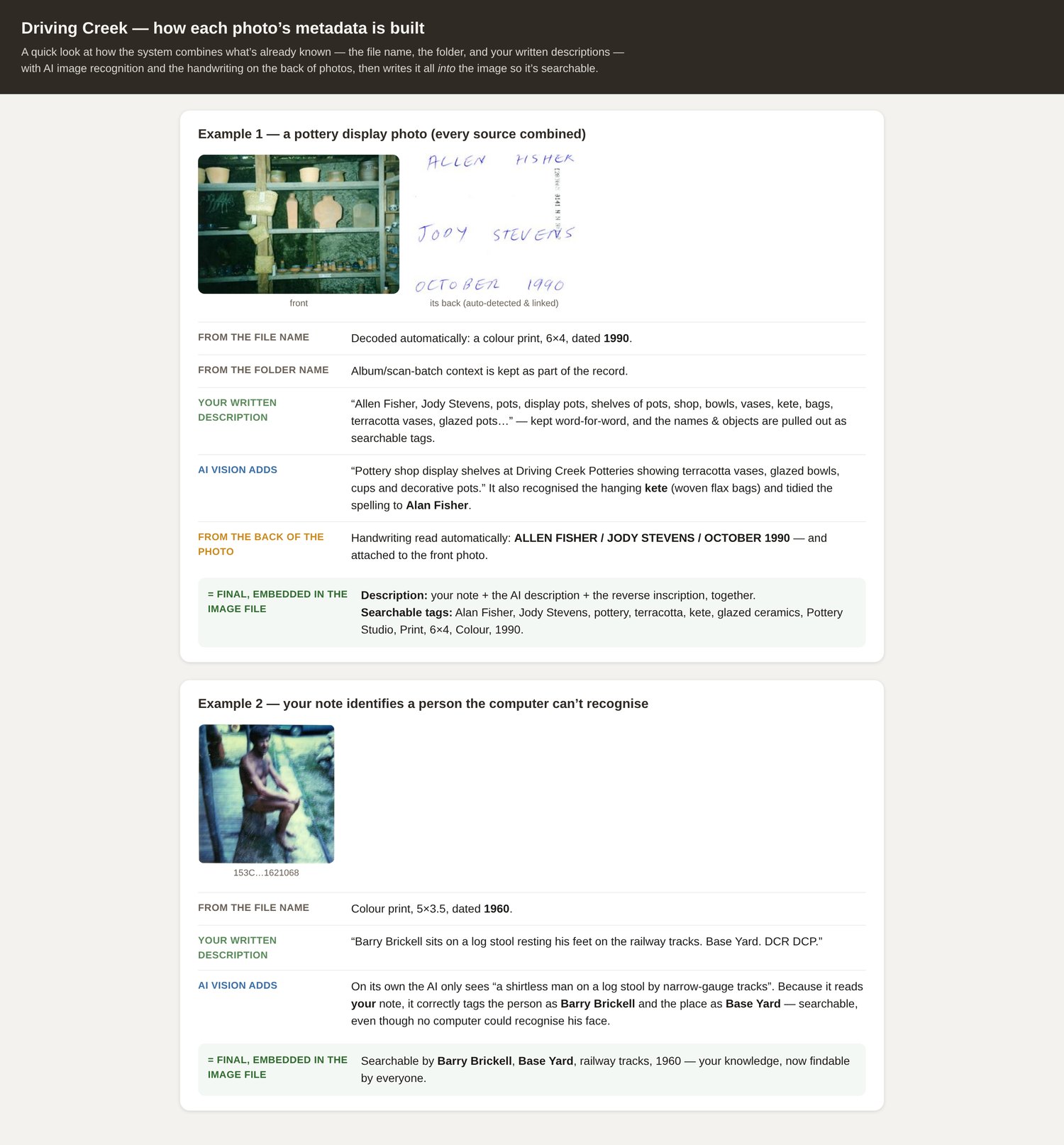
An explainer showing how each photo's final record is built from the filename, folder, your written description, the AI vision output, and the handwriting on the back.
Proven on a real collection
35,575
photographs catalogued (~130 GB)
3,147
photo-backs read & linked
950+
people made filterable
~1¢
AI cost per image
Who it's for

Built for small custodians of visual heritage.

If you hold a valuable image collection with a tiny team and little budget, you're who we built this for.

Historical societies & community archives

Boxes of scans and one volunteer who "knows where everything is." We make that knowledge searchable — and safe.

Small & regional museums

A thin accessioning spreadsheet and a mandate to go online, but no money for enterprise software. We bridge the gap.

Heritage railways & preservation trusts

Decades of construction, operations and people, impossible to search by subject. We capture your locomotives, structures and stories.

Marae, iwi & cultural collections

Taonga imagery that needs both findability and private, controllable access — kept in your own files, never handed to a platform.

Family estates & legacy projects

A notable life's photographic legacy, turned from a shoebox on a drive into a curated, searchable, durable archive.

Not sure if it's you?

If you've got more images than anyone can find, let's talk. The first conversation is free.

How we work with you

Your archive stays yours.

We're custodians, not a platform. Everything we do is designed so you keep control and lose nothing.

Your files, your drive

Originals never leave your possession. We work with your collection, we don't take it.

No lock-in, ever

Knowledge is written into your photos in open standards. Walk away any time and it's still there.

Human judgement kept

Your archivists' work is preserved and amplified, never overwritten. Every edit is yours to keep.

Tailored to your collection

We tune the vocabulary to your real people, places and terms — so the results sound like your institution.

Let's make your collection findable.

Tell us a little about your archive and we'll show you what's possible. The first conversation is free, and there's no obligation.

Book a consultation Not ready yet? Take another look at a real archive first →